In light of recent events

My daughter started kindergarten at her local public school this week. To pick her up in the afternoon, I have to buzz the office so that they can unlock the front doors and let me in the building. Once I’m inside, I cannot walk to the gym or playground or art room to fetch my daughter from after-care. A staff member has to escort her to the front office, where I wait, peeking through the window, like someone visiting a prison inmate. Yesterday afternoon, she was disappointed that I had come to pick her up so early; she wanted to go back out to the playground for just five or ten more minutes. “Pleeeeaaase!?” When I asked the receptionist at the front desk if I could accompany her back outside for a little while, I was told that I could not “because of the other kids out there.” I felt surprised, stung, even insulted, but acquiesced. As a teacher, myself, I understand that these are the more or less reasonable precautions our schools now take to protect children from the increasingly unreasonable world in which we all live. 

Earlier the same day, in fact, I had completed a lengthy online training course ostensibly designed to help me respond to an active shooter situation, should one arise at my own school. It left me feeling afraid, numb, desperate, anxious and depressed. A second required active shooter training is scheduled for later this week. I dread it already. Front-loading our faculty in-service week with this kind of thing casts a pall over the year to come in a way I never experienced when I began my teaching career sixteen years ago. Already, I can anticipate a likely response: Things change; we must adapt. To which I reply, you’re right. Things do change. Why don’t we adapt our fucking gun laws?

Needless to say, I believe there are better ways to address this dire–and mounting–problem. The strategies implemented by our educational institutions seem to be, by and large, defensive ones. We’ve put up gates and locked them, we’ve installed cameras everywhere, easy entry to our buildings is barred, we’ve increased the number of armed security and police officers, we’re training our teachers and students to Alert! Lockdown! Inform! Retaliate! Evacuate! Subdue! Distract! Or any number of other acronym-ready imperatives. And these initiatives have not been without cost. Someone is–indeed, many are–profiting from them. We have clearly been sold on this as the solution, but I wonder if it might not, ultimately, compound the problem.

What kind of emotional and psychological climate are these quasi-militant protocols creating for the children and adults who spend the better part of their days in schools? What are they teaching us to believe and expect about the world, and about one another? Are they not normalizing the threat of violence? Worse yet, mightn’t they be fomenting it?

Not being able to enter my daughter’s elementary school; not being able to go see her, her peers, and her teachers as they participate in its daily life; not being able to get to know this new community to which I thought I belonged, is profoundly sad and strange. What do I feel when I buzz the ringer by the locked front doors of a public building, or wait in its office? Criminal, though I have done nothing. I feel alienated, suspect, and eager to leave. More importantly, as our children witness us go through these increasingly rote motions of caution and precaution, what do they feel? How do they internalize the glaring paradoxes of their environment? Why should they keep coming to a place that explicitly concedes, through all of these alarming new safety measures, that it isn’t, in fact, safe?
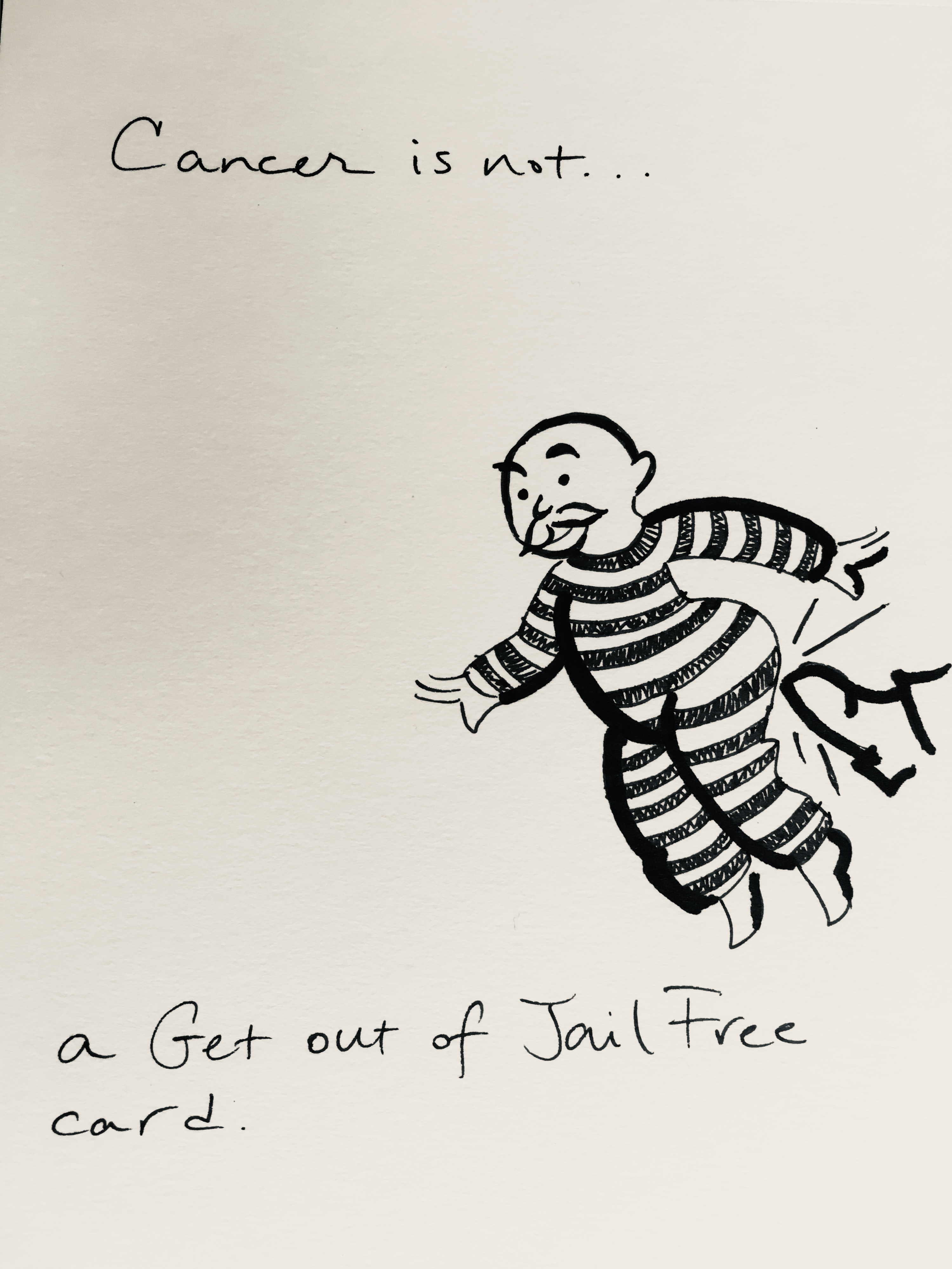
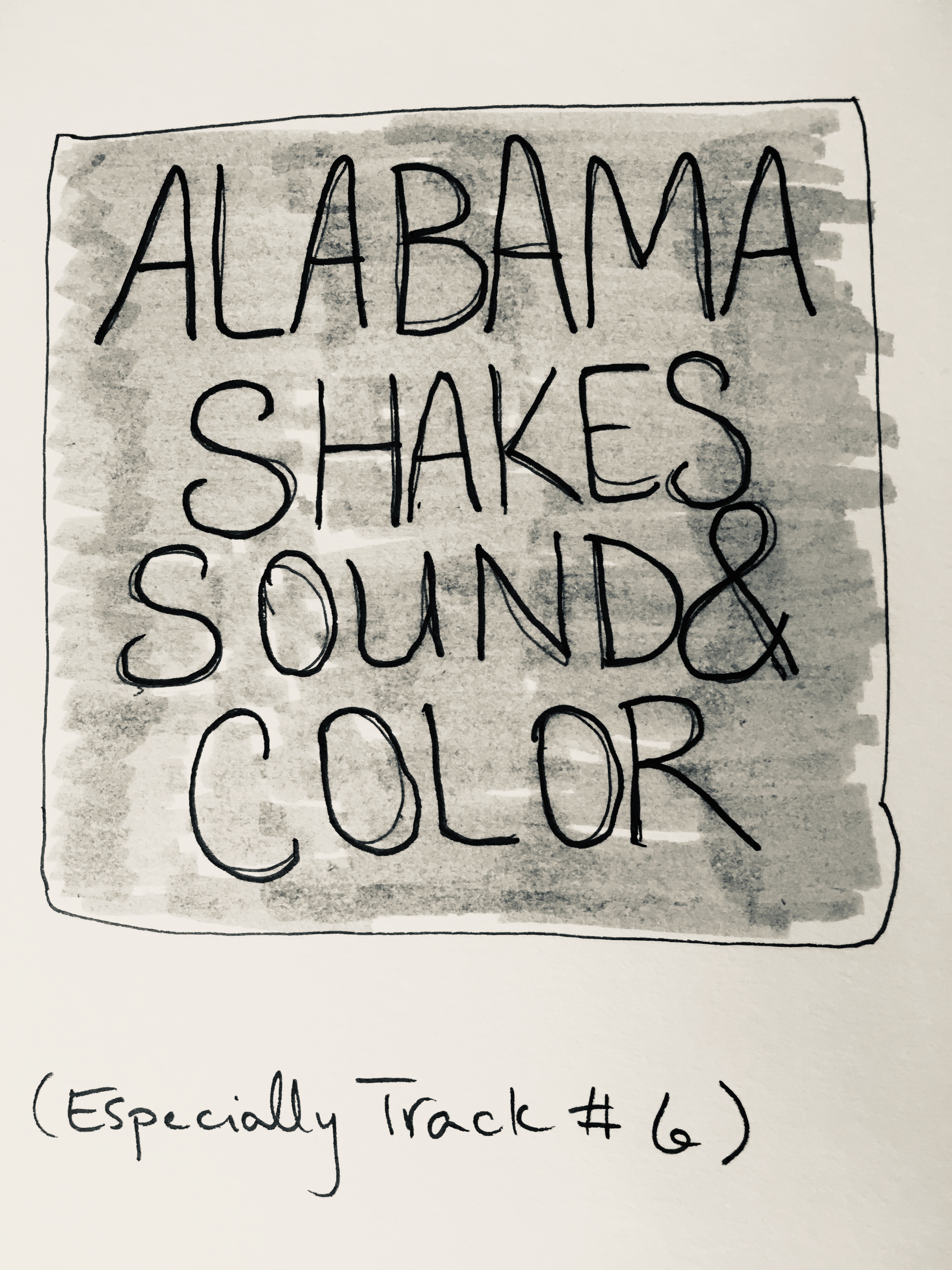
A new cartoon series, cont’d…

I drew this cartoon in the thick of my treatment on a particularly rough day. As I recall, I got a flat tire on the way home from radiation, my daughter was being a total pain in the neck, and the cat had vomited all over the rug when I finally made it back to the house. I remember thinking, incredulously, “Wait a minute… Other bad stuff can’t happen right now; I have cancer!” Turns out, it can–and does–happen.

Par example, last week I had planned a family beach trip to, in the words of my surgeon, “relax and enjoy the summer.” But the day before we were scheduled to leave, my husband stepped in a yellow jacket nest while doing yard-work and went into anaphylactic shock. He was rushed to the emergency room in an ambulance and spent the night in the hospital under close observation. It was awful. And, yet again, I was incredulous. Really, universe?!? Does our family not deserve some small reprieve after the world’s shittiest spring? But, as I should well know by now, it’s not really a question of “deserving.” These things are a matter of chance (hence the term, “misfortune”); as far as I can tell, human suffering is meted out unevenly and at random. And there are many people for whom it is much greater, or more dire. My husband is alright, we eventually made it to the beach, and some version of relaxation and enjoyment was had. It was not what I’d envisioned, initially, but we made do.

Sometimes, I taunt myself with the idea of someone out there in the world whose life is one of utter ease, without pain, conflict, illness, or injury, who just hums along without encountering unexpected obstacles, like a train on a greased track. I don’t actually know this person, most likely because she doesn’t exist. We also have a tendency to conceal our individual struggles, perhaps out of a sense of shame, which further promulgates that fantasy–the uninterrupted life of utter ease (or, if it’s more your thing, astounding productivity). Either way, I thought I’d share our recent mishap here to counteract that narrative–to remind myself that, even if it’s slow and squeaky, the train has not derailed. We keep chugging along, and I’m grateful for it .

It’s the strangest thing…

I’m now seven weeks out from radiation, and can happily report that much has improved. I can eat almost anything I like, with the exception of some meats. My energy is back, and I’m not in any physical pain. But emotionally, I’ve struggled. Life has felt oddly amorphous as I’ve healed. Rejoining the land of the living/well was more of a difficult transition than I thought it would be. Kind of like a war veteran readjusting to civilian life, but not. I miss being surrounded by others who are experiencing something similar to what I’m going through, or have gone through (i.e., the quiet confederacy of medical waiting rooms). I miss the myopic focus that illness induces–its consuming totality. I’ll even admit, with no small amount of shame and surprise, that I miss the attention that comes with it from everybody else. These are not things I anticipated feeling once I was on the other side of this. In fact, I naively thought that, if I was lucky enough to get to the other side of this, I would never have a bad day again. I would just feel so damn grateful to be alive, eating, and well, that there wouldn’t be room for any other emotions (particularly, negative ones).

But feelings, even gratitude, even joy, even (thank god) excruciating pain, move in and out like weather. And it has been this–the incessant changes to my body and outlook over the past six months–that has proven the most difficult to navigate. In December, I thought I might be dying. In May, I was granted a stay of execution. The time in-between was like nothing I’d experienced before. No wonder that, in returning to “normalcy”, I feel like a stranger, or interloper, in a place that was once quite familiar.

It’s hard for me to explain, but Katharine Smyth gets at this with astounding precision in her memoir, All the Lives We Ever Lived. Virginia Woolf, she writes, makes “a serious argument for how illness separates us from the healthy, whom she calls ‘the army of the upright’, and how, for the invalid, ‘the whole landscape of life lies remote and fair, like the shore seen from a ship far out at sea.’ […] It must be so difficult to bid farewell to one’s secret world of illness, and perhaps more difficult still to reclaim and trust in one’s new place among the living.” Indeed.

Or maybe…

I’ll lean right the fuck into it. The future, that is. I’ve had a profoundly reassuring week, and I figure I should share the good news here, just as I have the bad. On Wednesday, I saw my surgical oncologist for the first time since he removed the stitches from my neck in February (and well before I began radiation). He said I looked great–that everything was healing wonderfully. Personally, I think anyone who’s not barfing all over themselves–which I was the last time we met–would get as favorable a review. But this was a relief to hear, nonetheless. I then asked him if my prognosis was good, and he told me I was in the best possible position I could be in with respect to that: the remaining tumor he’d removed from my tongue was small, my lymph nodes had been clear of cancer, and they staged it at I. “You can relax and enjoy your summer now,” he said. “The hard part is behind you.”

Hearing this was like a benediction. They’ll still continue to monitor me via CT scans of my head and neck for the next five years, of course, but there’s good reason to believe I just might be alright. The doctor then asked if I wanted a referral to a plastic surgeon to see if they might be able to laser off the long scar on the side of my neck. “I know it can make people self-conscious,” he explained. I declined. I’m strangely proud of it. As I read the other night in the knock-your-socks-off memoir, All the Lives We Ever Lived: Seeking Solace in Virginia Woolf by Katharine Smyth: “We are each of us circumscribed within a body, the shape of which, the scars on which, the holes within which, tell our tale if you care to read it.” I actually now have two scars on my neck, the one from my recent lymph node excision and another, fainter one, across the base of my throat from a partial thyroidectomy I had at age twenty-one. My daughter likes to trace her finger over them when she’s lying in my lap. It looks like I survived the guillotine or something. Twice.

Then today, I saw my speech therapist, who also gave me a good report. She observed me chew and swallow a few sample foods they keep on hand (the graham cracker was a challenge), and said she was impressed with my progress. She encouraged me to continue doing my weird tongue exercises, as latent complications from the radiation can occur as long as five or ten years down the road. So I figure I’ll try to do them when I’m driving and give anyone who happens to pull up next to me a good laugh.

When I got in the car to head home after this appointment, I cried. The weather outside was so fittingly, beautifully bright it seemed staged. I still feel the clench of fear in my gut when I think of everything I’ve been through (and will continue to go through in the coming months and years), but I’d like to give myself permission, as my doctor did, to feel joy a little more fully, too. I’ve always been frugal with this emotion, bearing (stupidly, constantly) in mind a line from Faulkner’s Absalom, Absalom! claiming that the minute you let down your guard is “the instant which Fate always picks out to blackjack you.” But what else is there to do, really? The house always wins, and yet you have to play. That’s the rub.

Turning the corner

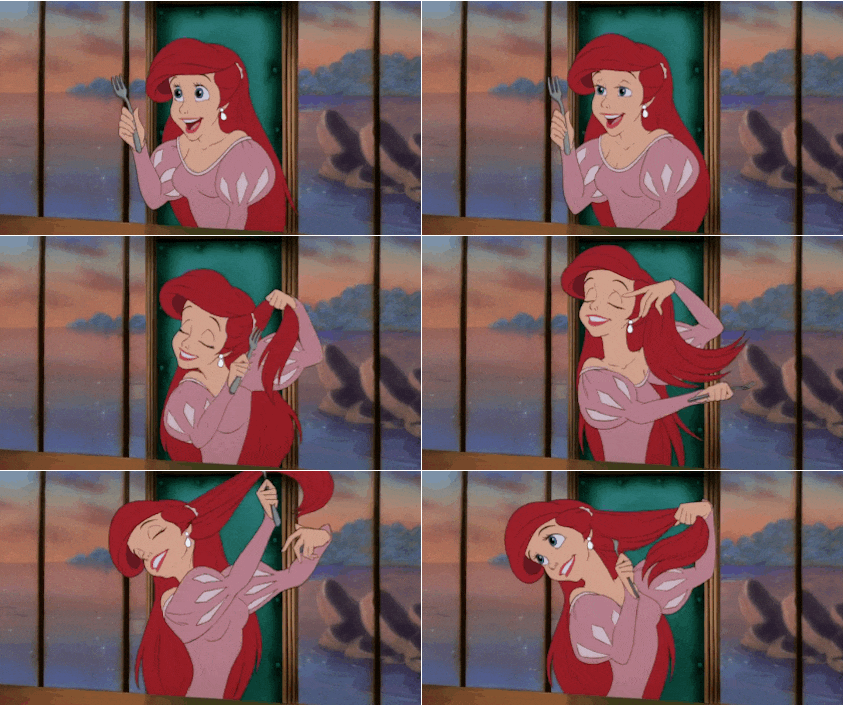
Well folks, I’m using a fork again. And not just on my hair. Over the past few days I’ve had some solid foods. They’ve had to be moist ( a god-awful word, I know) because my mouth is still very dry and my saliva is pasty (perhaps an even worse word). I can only manage a few bites, not an entire meal, but this is progress given where I was a week ago. I’ve found some success with watermelon, over easy eggs, well dressed salad (romaine lettuce only), tzatziki yogurt, peaches… In short, anything with a high water content that sort of salivates for you (man, do I feel sorry for my readers who are not, themselves, recovering from oral radiation. These past few posts must be a total bore. If I happen to have any readers who are recovering from oral radiation, take heart. Things do improve, albeit gradually). I’d say food tastes about 70% the way it used to. Chewing and swallowing remain slow and effortful, so eating still isn’t really a source of pleasure. But I’m beginning to believe it might be again someday…

It’s funny, I have a newfound wariness of that word (i.e., someday). Of the future in general, really. I don’t know whether I can lean into it fully–whether it will support me. So much of what I used to to take for granted has become a big IF… If the treatment worked… If my next scans are clear… It’s hard to inhabit the conditional and contingent, despite the fact that this is where we always already are. I’m treading lightly, I guess you could say, my heart a kind of rookery where the birds are liable to startle and take flight at any minute. A tall drink is definitely in order.

Radiation: 3 weeks out

The glory of a month free of radiation.

Today marks three full weeks since I completed radiation. My doctors have said that recovery usually takes about six weeks, so I’m halfway there. The most marked change I’ve noticed is in my energy level. I now feel pretty much back to normal in that respect. I’ve resumed my walks, and feel comfortable being out and about. I think weaning off of my pain medications has helped me feel less fatigued and drowsy (not to mention, allowed me to drive again). Speaking at length is still difficult, which concerns me given the fact that I’m due back in the classroom in August. But hopefully, that will continue to improve, along with my enunciation.

The main side effect that remains unchanged is my diet. While the flavor of some foods is gradually returning, my ability to chew and swallow them has not. So I’m still on liquids. The same liquids. Like my surgeon and radiation oncologist predicted, I’ve lost twenty-two pounds since all this began. It’s actually becoming a concern, as an unexpected–but, oddly convenient–corollary of radiation is a loss of appetite. I don’t really feel hungry any more. Meals (and I use the term loosely) are something I make myself have; they’re not something I want. In a way, this is a bit of a blessing. It would be a torment to sit down with my family at dinner and find myself craving what they were eating, but I don’t. The challenge now is making sure I get enough calories to continue to heal and have energy given this odd indifference towards food.

And it is odd. For as long as I can remember, eating has always been associated with very strong emotions–desire, anticipation, pleasure, anxiety, satiety, belonging, frustration, disappointment, loneliness, discovery. It has never been a source of apathy. As with most things I’ve experienced since my diagnosis, this altered relationship to something so fundamental has been double-edged. On the one hand, it’s surprisingly freeing. I’m doing more with a lot less. There’s some time and psychological space that’s opened up where food used to be. I see that, perhaps, the ascetics were onto something. But I also mourn its loss, its familiarity, its rituals. Again, temporarily. I’ve been told that my appetite and ability to eat will return again at some point. I just don’t know when.

Healing is hard work, cont’d.

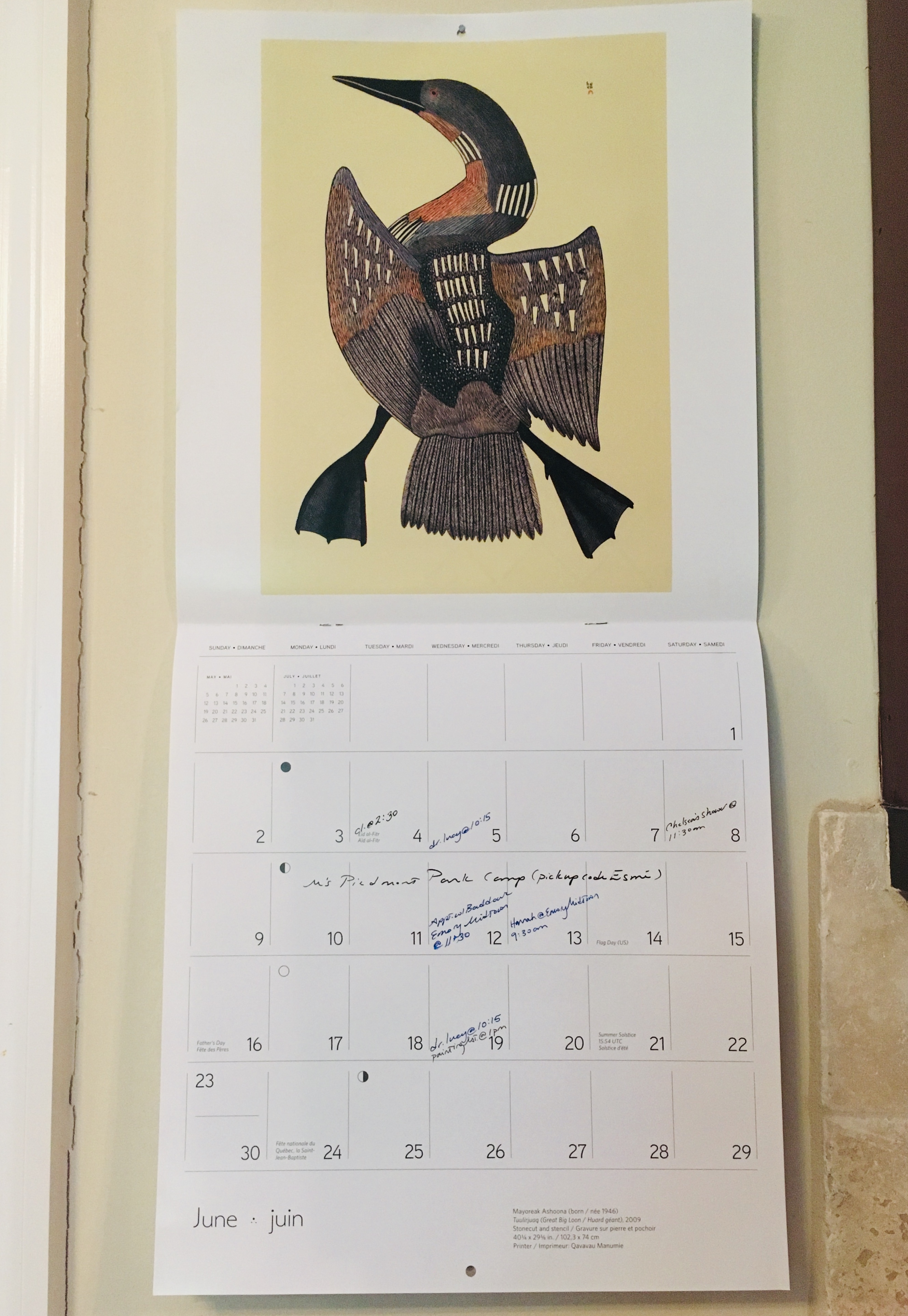
I haven’t written in a while because I’ve been waiting for “news” to report. That is to say, some kind of change or improvement. There has been change and, I suppose, modest improvement. The sores on my tongue and the walls of my mouth have more or less healed, and the pain I felt in my throat when I swallowed has migrated to my right ear. In fact, that’s pretty much the only pain I feel anymore and it’s lessening, little by little, each day. This is most fortunate, considering the fact that I’ve been weaning off of Oxycodone over the past week. Next week, I will be weaning off of Gabapentin, but supplementing all the while with Advil and Tylenol. I also feel my energy returning, but slowly and in small increments. A single outing or errand will still wear me out more than it ever used to.

I think the next challenge in my healing process will probably be figuring out food. My last actual meal was on April 14, which I know thanks to this blog. I’ve been on a liquid diet for forty-four days now, and a limited one, at that. Given the changes to my taste buds, the only things I’ve found tolerable over the past month-and-a-half have been water, Ensure, butternut squash soup, drinkable yogurt, and vanilla milkshakes. That’s it. That’s what I have every. single. day. At the behest of my speech therapist, I will try a bite of something else here and there (applesauce, mashed potatoes, cottage cheese, other soups, etc.), but these either taste terrible, or I can’t manage to swallow them. My natural saliva production, which I’ve learned helps break down food as you chew, has gone completely haywire, and food will simply get stuck to my teeth, tongue, or the roof of my mouth, causing pain and discomfort. It’s really very frustrating. So, I stick with what I know works because my body needs calories to heal.

Much like a recovering alcoholic, I’ve started to realize how heavily our social rituals revolve around food and drink. It’s hard when you can’t participate, and a little lonely. But it’s not the end of the world. And, in my case, it’s hopefully temporary. I just wish I knew when I’ll be able to eat again. No one has told me, and I can’t find it in the two other MASC blogs I’ve located on the internet. It’s hard to continue to be patient, and to live with uncertainty. That’s pretty much the crux of this entire ordeal, in fact, from my diagnosis right up until now. A serious illness pulls the rug of certainty out from under you, and it’s difficult to regain your footing. I still have my sea legs, I guess, and might for a while.

Healing is hard work

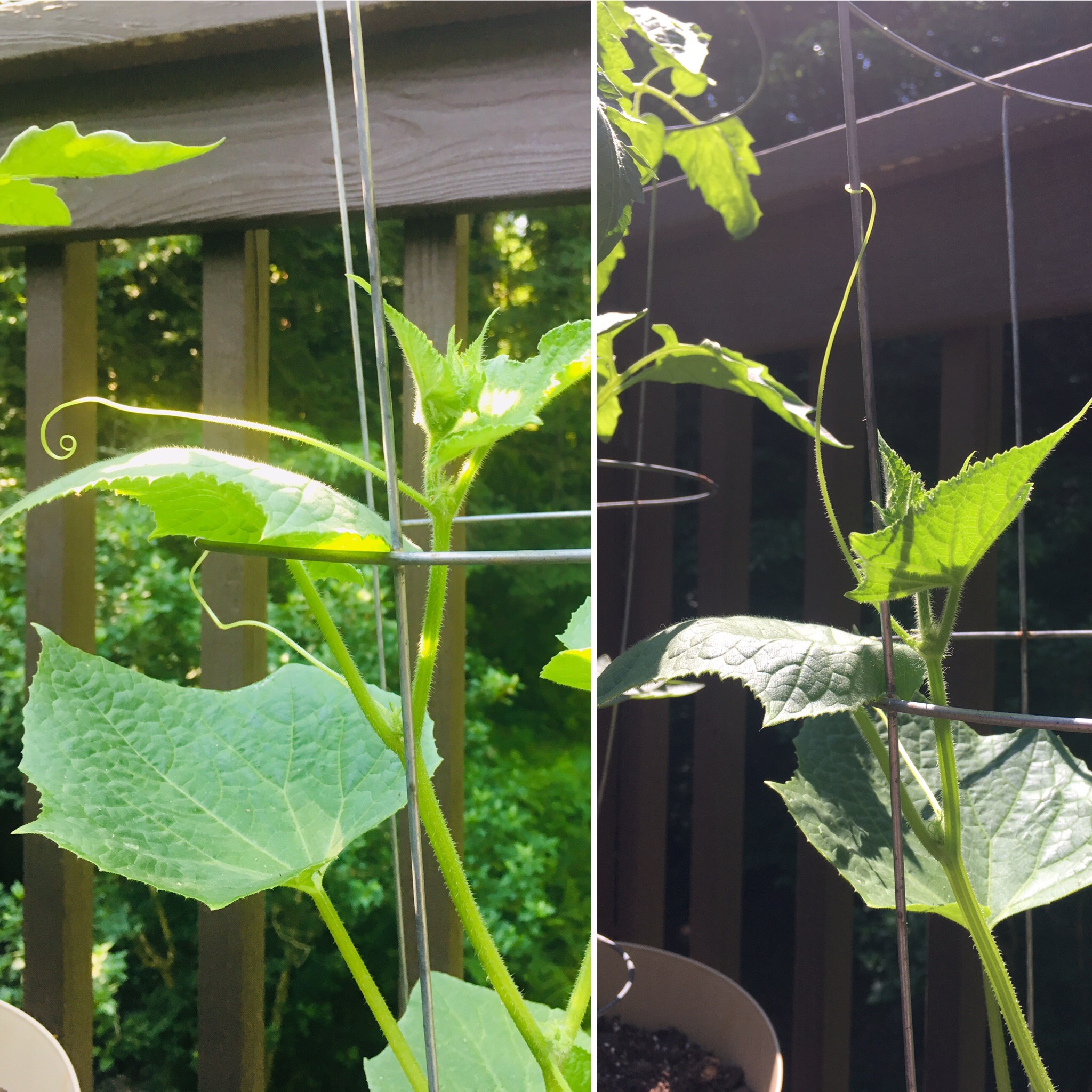
Consider the cucumber. We bought one at a plant sale my daughter’s school was having, and watching it grow has been fascinating. The students staffing the sale told us that cucumbers are climbing vines, and would need a trellis or cage to latch onto (if you’re an avid gardener, you already know this, but I’m a novice; I try to grow a few potted vegetables and herbs every summer, with varying degrees of success). We followed their instructions, and I was awed by the first little tendril that unfurled from the stem, delicately coiled as calligraphy. It listed far from the cage and I thought, there’s no way it will latch onto that! It seemed blind, like a worm or some deep sea creature, tonguing its way, vainly, into the air. But then, a day or so later, this tendril had somehow found the thin metal rib of the cage, and curled around it with such grace and precision that I felt oddly moved. That nature is ingenious and resourceful shouldn’t surprise me, but it did. It struck me as miraculous that this seemingly lost and fragile fledgling of a stem found what it needed in the night, even though it’s merely a rote machination of the plant–what it does, what it’s designed to do.

I’ve wondered if my body is functioning in a similar way. I wonder how much invisible work it does every night to heal and repair what has been ravaged. And I’ve wondered how it knows to do this, without any books, instruction, or bidding. I was in so much pain last week, and felt so vulnerable, that I couldn’t believe my doctors had sent me home to deal with it, alone. I don’t see my radiation oncologist again for six weeks. Six weeks! I would think to myself, enraged and incredulous that I’d been left to flounder through the hardest part of all this, unmonitored. But maybe it’s because there’s really nothing she could do for me, aside from prescribing the heavy regimen of pain meds. Maybe she knew that my body would begin to heal itself on its own, and my job now is to simply wait it out. Only it’s not so simple, because the process has been slow and strangely hidden from me. I wake each morning wondering how I will feel–whether the pain will have subsided some, or my energy returned. Whether my body, in its distress, will have found some kind of mooring.