#birthdaymoon #eecummings

Cancer, conundrums, cartoons
#birthdaymoon #eecummings
I have Covid. Again. I got it exactly one year ago this past weekend, which I remember because it was Labor Day. The delta variant then and omicron now, I assume. Before and in-between, I’ve been fully vaxxed and boosted and am beyond grateful for this, as my symptoms have been those of a nasty head cold and not much more. But I find myself curiously sidelined from life again (much like I was during our long year-and-a-half of sheltering in place and, prior to that, my treatment for cancer), which has me feeling both reflective and a little bored. How I used to live in mortal fear of this virus that I now experience as a minor annoyance! And how I know that that fear was warranted because it’s claimed so many lives but also, perhaps, excessive because I’m relatively young and healthy and have taken all of the necessary precautions that have been available to me (masking, distancing, becoming vaccinated as soon as I was eligible, quarantining when I’ve been sick, etc.). Did my fear protect me in those early days when we all knew so little about the strange virus ravaging virtually every corner of the globe? It certainly influenced my behavior and decisions, so perhaps. And I remind myself that it was also shared by my doctors, who advised me to exercise caution because of my recent cancer diagnosis and treatment. But did my fear also inhibit me in ways that it needn’t have; did it cause undue suffering and isolation and anger and, at times, despair? Yes. Increasingly, the longer I live (or am lucky enough to live), the more I find myself confronting–even inhabiting–paradox. That is, two (or even more!) opposing claims, feelings, or realities being true at once. Logic tells us that this cannot be so, but experience consistently (and maddeningly) proves otherwise. I’m sure those older and wiser than myself know this; perhaps they’ve even tried to tell me as I’ve struggled to shape the morass of life into something clean and solid and coherent. Hellbent upon this furious yet futile task, I’m guessing I didn’t listen, or was unable to. Perhaps those who loved me left me to my work and those who didn’t laughed at it; either way, the lesson may be just starting to sink in now. It takes a long time to learn some things. Some days, after the upheavals of the past five years, in which so many of my certainties were shattered (or rather exposed for being assumptions and nothing more), I feel as though I’ve just been born. Like I’m looking out on the world with eyes that are newly opened, nothing quite in focus.
Yet.
When I was little, I used to be a serious “Star Search” fan. I remember watching the erstwhile 80s television show in the afternoons (or was it early evening?) while seated criss-cross-applesauce on the living room floor. I felt great fondness for its affable host, Ed McMahon, and great awe for the daily parade of talent to which it made me feel uniquely privy. My seven-or-eight-year-old self relished the neatly demarcated categories–modeling; stand-up comedy; singing and dancing, be it group, junior, or adult–eagerly anticipating each like the courses of an elaborate meal. Though a harbinger of the many noxious “reality” competitions that followed in its wake, “Star Search” still seems like a more innocent, less exploitive iteration of the variety show genre (think “Lawrence Welk” or “Soul Train”). Or maybe it’s just that I was more innocent. At any rate, as I’ve continued to weather the strange, slow slog of this pandemic, one “Star Search,” in particular, keeps coming vividly to mind.
I remember an episode that featured a contortionist in what must have been a category all its own. A surprisingly tall, lean, youngish man walked out onstage, clad in only a Speedo. His oddly hirsute swimmer’s build was accentuated not only by a deep tan, but what must have been body oil. This, alone, set my second-or-third-grade jaw agape. Next to him stood a clear glass cube, maybe about 3 x 3 X 3 ft. large. McMahon explained that said Adonis would be ensconcing himself entirely in said cube in under one minute. My incredulous response: NO. WAY. (Mind you, this was long before Cirque du Soleil, with its panoply of Twizzlerlike performers.)
Cue the suspenseful, reverb-laden music and the stop-clock. Utterly mesmerized, I watched as this man carefully folded himself into the cube like a piece of human origami, one lengthy, greasy limb at a time. First, a foot and leg outstretched, then awkwardly angled and bent into the box, like an insect’s. Tail and torso were next, followed by an arm that snaked around the opposite leg and, finally, the contortionist’s head, which he tucked into his armpit like a sleeping swan. It was like witnessing a breech birth in reverse. Once he was completely inside, a sequin-spangled assistant closed the side door of the cube and the man’s flesh pooled against the glass to which it was pressed. His entire body became a clenched fist, the clear glass around him suddenly clouding with the vapor from his breath. The assistant slowly spun the box on its rotating pedestal while I watched, unblinking, in horror and fascination.
Why does this image return to me so forcefully now? The answer seems fairly obvious: is this not how we’ve all been living, to some degree or another, for nearly a year? Surely I can’t be alone in marveling at the sudden contraction of our lives as a result of COVID. And, with vaccines and something like hope on the horizon, I realize I’ve forgotten something rather crucial about that episode–namely, how the contortionist got back out of the box. No doubt this required just as much time, torque, and flexibility as getting into it, if not more.
I can manage if I pretend these are my last days. As such, I scale back any and all expectations. I shift from waiting to living, from living to being. What would I do with my last days? Precisely what I am doing. I would write. I would take a walk, slowing my pace considerably and lengthening my loop. I would talk to my mother on the phone. I would make something in the kitchen. I would ride bikes with my daughter. I would read a bit, listen to music, and watch late night television curled on the couch next to my husband. I would take note of the day’s shifting sunlight, the birds at our feeder. I would pet the cat and dump the compost. I would have a glass of wine with dinner, and draw my daughter’s bath. I would call a friend.
What is missing from this list are the things that have been missing from my life for the past nine months (incidentally, the gestation period for a whole new human). Some, I have happily gone without: dental appointments, buying stuff, attending children’s birthday parties nearly every weekend, troubleshooting the copy machine at work (ok, that’s a lie. I always rope someone else into fixing it), using public restrooms. Others, I miss so much it craters me: actually seeing friends and family, hugging them, and sharing a meal. Or, barring that, knowing when I will be able to again. Moving through densely peopled places without anxiety. Overhearing my daughter play with a friend in her room or watching them collide gleefully on the playground. Helping others in ways that are familiar to me. Attending a yoga class in the studio or visiting the library. Accompanying my parents to mass. Shaking a stranger’s hand. Believing tomorrow might be better.
And then I course correct–remind myself that tomorrow is irrelevant. There is only today, and it is good.

Or at least, they might be. In our doubling down on all things analogue during the pandemic (e.g. puzzles, charades, listening to records, etc.), my six-year-old has recently taken up roller skating. She practices in the empty lot of a now deserted business park, as our own neighborhood roads are too curvy and hilly for comfort. Watching her learn this new skill has been an unexpected delight. Like a newborn foal, she wobbles and lurches on her impossibly long legs before finding her center of gravity and nosing forward, then backward, and, often enough, straight down. Each time, she gets back up with a kind of relish that I’m beginning to understand, myself.
While the difficulties of pandemic parenting are legion, there are some sweet spots. I’m just not always in the frame of mind to appreciate them. But watching her try, and fail, and try again, to skate the other day reminded me so vividly of her first few steps when she was just learning to walk that my own knees gave a bit. I love every iteration of her, I thought to myself. What’s more, I will. This bearing witness, for I don’t know what else to call it, to her growth and change and fledgling autonomy is one of the incomparable joys of being a parent, and I’m not sure I would have experienced it in quite the same way–if at all–had the world not been knocked sideways by competing crises.
I can’t possibly explain what’s happening–the strangeness of these quarantimes–so I’ll explain what’s happening (i.e. I cannot go on. I’ll go on). Some of it occurs outside, but much of it is inside. The earth keeps spinning, improbably, upon its axis. With the recent rains, we’ve discovered an abundance of tiny tree frogs around the deck. My daughter captures one or two each morning, and loses or releases them by the afternoon. We’ve also taken to walking them, like the dog we don’t have. It was her idea; she perches one on the thin metal stretcher under the canopy of her open umbrella and off we go. Slowly, of course, like 19th century flaneurs with their turtles. The frog grips the teeny, tiny rod with its teeny, tiny feet, rarely jumping or moving during our solemn daily promenade. I like to think they enjoy it, but of course I don’t know.
My husband listens to increasingly loud, experimental music when he’s in the shower. I think it’s an attempt to approximate his old commute, which now just involves walking downstairs.
I often feel like lying face down in the road or someone else’s lawn, just to see if anyone stops to inquire after me, or to join in the prostration, themselves. I refrain from this, however. I refrain from so much.
We’ve made an anemometer out of toilet paper cores and plastic straws. We’ve learned what an anemometer is. We sit through the tedium that is virtual learning–my daughter’s school’s as well as mine. The voices of children, even online, are so lovely; their use of all caps in the chat box, so liberal. I envy them this.
The days feel bloated and amorphous, yet my desires grow sharp with specificity. My dreams, likewise, are laughably transparent. I ration the new Pen15 episodes like I did flour in March. Somewhere in all this, I got another clear CT scan and celebrated quietly. But it was not without bitterness and bemusement that I thought to myself, This was when I was really supposed to be living life, you know? After last year’s diagnosis and treatment and recovery… And so I am, such as it is.
A while ago, I came across this great list of words that mean their opposites and lately, I’ve been thinking about another one: grounded. On the one hand, this can mean “well balanced and sensible,” (thanks, Google Dictionary). But it can also, in its adjectival form, mean “(of a child being punished) not allowed to participate in social or recreational activities.” As a result of the pandemic, I’ve been living both definitions simultaneously. On the one hand, my days consist of the only things that truly matter–home, family, work, sustenance. In our nearly monastic seclusion, we’ve dropped off the hamster wheel of needless consumption, and it’s been quite liberating. Life feels pared down to its essentials (yet another word COVID has revised the meaning of). But it has also felt incredibly restrictive. And I find myself wanting to rebel against those restrictions in precisely the same ways I did when I was grounded as a teenager–namely, sulking, seething, sneaking out, acting up. The irony, of course, is that my current sentence is largely self-imposed, and I don’t know when it will end. I just didn’t expect to feel cheated out of the crime spree that would warrant this prolonged state of house arrest, though I suppose if I looked carefully enough, I could find an infraction or two.
Today I am twenty-six and wandering the steep streets of Lisbon, alone. The sun is hot, the angle of its light here, extraordinary. I don’t know if I’ve ever flexed the muscles of my memory and imagination quite as often as I do now. Like everything else, they seem to have atrophied as I’ve grown older. But some faculties remain strong–are even, perhaps, getting stronger. The anguish, for example, with which I look on my daughter as she plays, alone, in the yard. We set out the sprinkler and she runs through it in a too-small-swimsuit from last summer. It’s been so long since she’s worn one that she forgets to take off her underwear first; a soggy hem peeks out. My fantasies are only ever of rescue anymore. When are you coming for me, I imagine asking. The reply for which I steel myself: I am not coming for you.
Increasingly, how I imagine life post-pandemic. #stillshelteringinplace
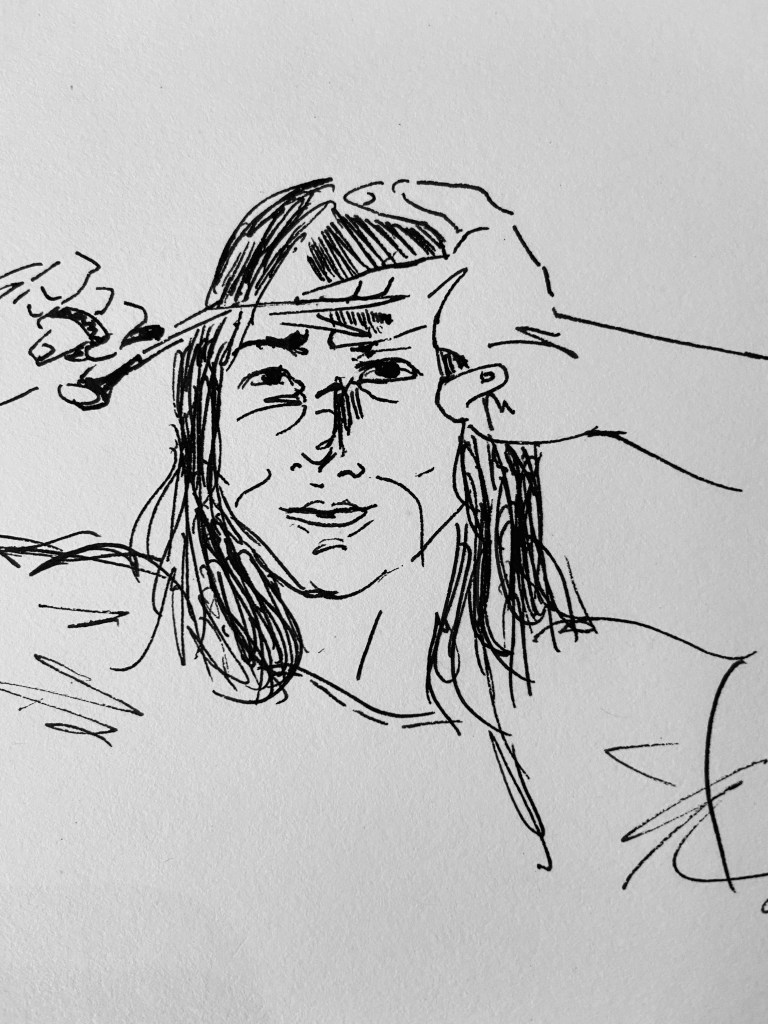
As in a dream or a Kafka story, I keep cutting my own bangs, yet they somehow remain the same length. I notice a strand (or two) that is suddenly as white as a cat’s whisker before wiping the trimmings from my face, the sink, the scissor blades. The task appears complete. But then, the very next day, my hair gets in my eyes again. Which either means it grows back overnight, or my forehead is shrinking?!?
 Well, then