
Yesterday I received news that my annual CT scan was clear, and it settled in the strangest way. I felt relief, of course, but not the utter elation I’d expected. I say this because it wasn’t your typical scan; if clear, it would be likely be my last. And lo, it was! Yet I felt… so many different things. Which suggests that perhaps few emotions or experiences in life are unalloyed, though some have come close. Anticlimactic as the news was (sadly, medical test results aren’t sent with confetti effect), I still found myself wishing there was someone I could meet for a spontaneous drink to celebrate, but I didn’t know who that person would be at 2:45pm on a Monday. So, at a loss despite this seismic gain, I drove to pick up my daughter in the very same car in which I drove to pick her up after receiving my diagnosis five years ago with an uncannily similar sense of bewilderment. Wow, I thought to myself, I’m still here; I’m in remission; I’ve been cancer-free for 5 years. 5 years! It feels like a thousand lifetimes have transpired since my diagnosis in 2018–-so many awful and unexpected things have happened on both a global and personal scale that I’ve struggled to account for much of any of it. But I could no more account for the grace or good fortune that’s befallen me throughout my life, either. Account. That’s kind of funny. To whom? For whom? I suppose mostly for myself and maybe my daughter, in the event that she becomes curious about all of this when she’s older. I write these things down because then they live on the page, outside of me, and not solely inside, which can be overwhelming. And I share them here on the off chance that they might help someone else going through something similar, just as the few blogs I found my way to in the wake of my diagnosis helped me. To paraphrase James Baldwin, you feel alone in your suffering, and then you read. Or write. Or lean on others (those who helped me get here are countless and range from strangers to closest kin; I offer my gratitude to each and every one of them ❤️ ). Or walk the dog you once wondered if you’d live long enough to be able to have. Cheers to that.
We’re not always wearing war paint
sometimes my body reminds me
that I am in it
the walls of your veins are thick
she says with annoyance
shouldn’t they be? I think with the same
the nurse is nonetheless kind (if also
impatient)
I recline in the chair, my head turned away
from the tourniquets and needles
and weep
which happens almost involuntarily now
whenever I am back where it all began
a year ago or so
as though in this position, passive and supine,
when things are being done to me
I finally have permission (or maybe it’s
privacy) to feel
everything I wouldn’t let myself
before
or
in-between
Birthday Greetings
Yesterday I turned 40. Cancer has changed my relationship to many things, time being first and foremost among them. I welcomed this birthday with elation, despite the fact that this particular age is dreaded by many. There’s no shortage of over-the-hill/you’re now officially OLD cards and other doomsday paraphernalia out there heralding one’s transition into a new decade (be it 30, 40, 50, or beyond), and I know, from observing those around me, that aging can be an especially fraught experience for women. There is so much cultural currency in youth and beauty–indeed, women often seem valued for these things, alone–that losing them is a terrifying prospect. But, after cancer, I can’t imagine begrudging a single birthday from here on out.
I covet all the years.
The postmodern poetry of pathology reports
For a time now, I’ve been able to put cancer behind me. I’m doing–and thinking about–other things. But this Friday, I have my first post-treatment CT scan, and it’s looming large on the horizon. I keep rehearsing the afternoon’s appointment in my head by recalling how things went down the first time. Drinking that awful barium sulfate solution, alone, in a freezing cold room; the brisk manner of nurses and lab techs; lying on yet another narrow table; feeling the contrast dye saturate my veins; repeating the mantra I said to myself, before, as the machine pivoted around me: My body is a dark city, my body is a dark city. Like London during the blackouts of WWII, I don’t want it to light up. (Obviously, my understanding of how these things work is vague, but I believe the radiologists are looking for some kind of “activity”–for cancer cells to react to the chemicals coursing through my body by luminescing.)
For some reason, my mind also keeps going back to my initial pathology report. I don’t know why doctors give these to patients; mine consisted of a dense paragraph of medical jargon followed by this stand-alone sentence, in all caps:
THE LESION IS MALIGNANT.
Reading it felt like the closest I might ever come to visiting an oracle. But what seemed, at the time, like a fixed decree–an intractable fate–has since revealed itself to be a bit more pliant. Much can still be done in the wake of such things; choices can still be made. Which may be why I’ve been questioning some of my own lately. Small ones, like becoming irritated in traffic, or with the endless stream of students filing into my classroom to borrow my stapler this morning. Do I, alone, have the earth’s last functioning stapler, I wondered. And then I took a deep breath, a proverbial step back. I do a lot of that now. Trying to notice how I’m responding to certain things and why. Trying to hold onto the perspective that the past nine months has brought, though it was dearly purchased (does perspective ever come cheaply?). Is this worth the worry or frustration it’s causing me? Can I let it go? We all have so many heavy things to carry. Friday’s appointment is one of mine.
A new cartoon series, cont’d…
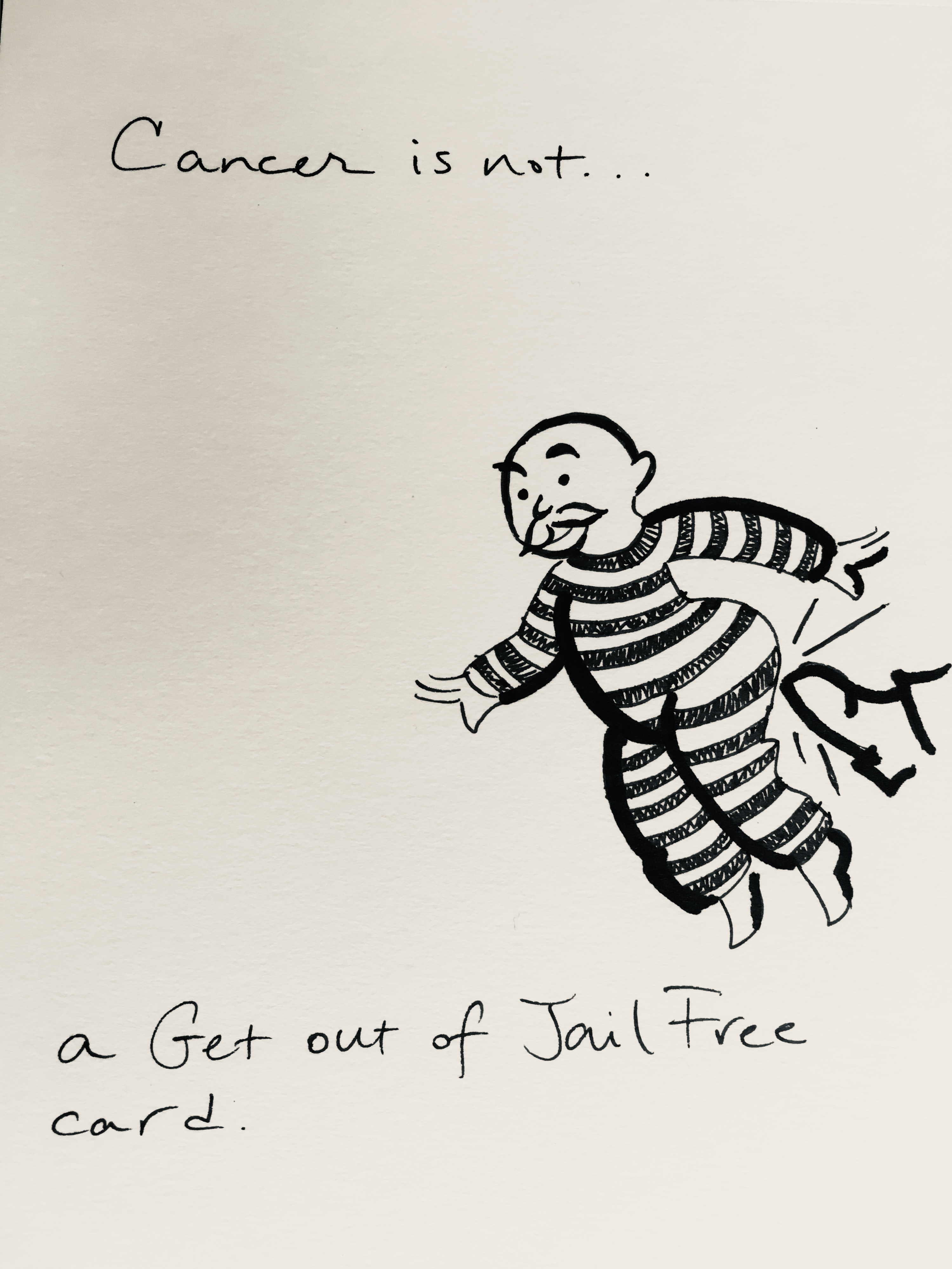
I drew this cartoon in the thick of my treatment on a particularly rough day. As I recall, I got a flat tire on the way home from radiation, my daughter was being a total pain in the neck, and the cat had vomited all over the rug when I finally made it back to the house. I remember thinking, incredulously, “Wait a minute… Other bad stuff can’t happen right now; I have cancer!” Turns out, it can–and does–happen.
Par example, last week I had planned a family beach trip to, in the words of my surgeon, “relax and enjoy the summer.” But the day before we were scheduled to leave, my husband stepped in a yellow jacket nest while doing yard-work and went into anaphylactic shock. He was rushed to the emergency room in an ambulance and spent the night in the hospital under close observation. It was awful. And, yet again, I was incredulous. Really, universe?!? Does our family not deserve some small reprieve after the world’s shittiest spring? But, as I should well know by now, it’s not really a question of “deserving.” These things are a matter of chance (hence the term, “misfortune”); as far as I can tell, human suffering is meted out unevenly and at random. And there are many people for whom it is much greater, or more dire. My husband is alright, we eventually made it to the beach, and some version of relaxation and enjoyment was had. It was not what I’d envisioned, initially, but we made do.
Sometimes, I taunt myself with the idea of someone out there in the world whose life is one of utter ease, without pain, conflict, illness, or injury, who just hums along without encountering unexpected obstacles, like a train on a greased track. I don’t actually know this person, most likely because she doesn’t exist. We also have a tendency to conceal our individual struggles, perhaps out of a sense of shame, which further promulgates that fantasy–the uninterrupted life of utter ease (or, if it’s more your thing, astounding productivity). Either way, I thought I’d share our recent mishap here to counteract that narrative–to remind myself that, even if it’s slow and squeaky, the train has not derailed. We keep chugging along, and I’m grateful for it .
When you haven’t used a fork in so long you’re like…
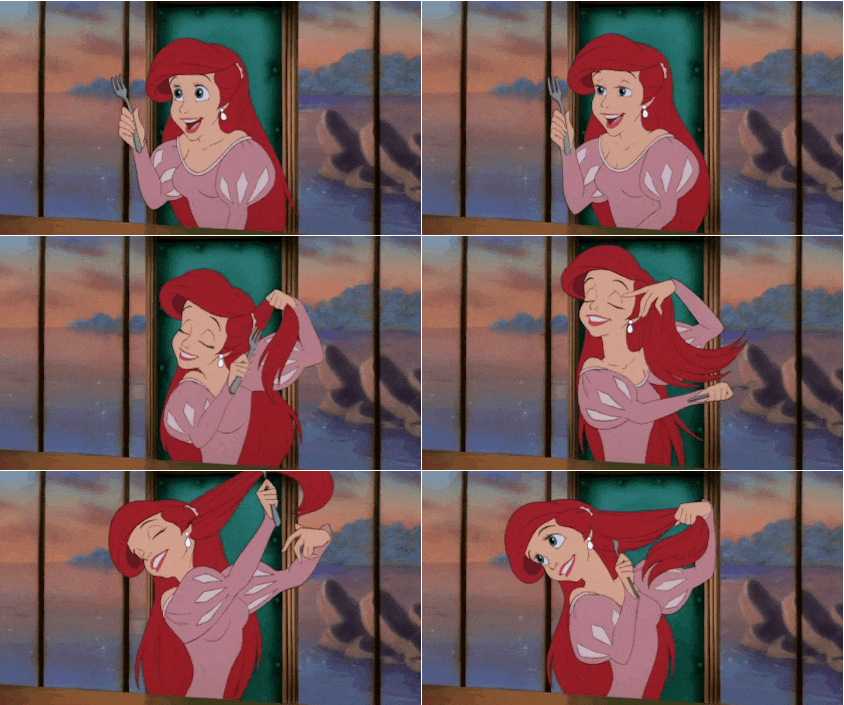
#oralcancer #radiationsideeffects
Healing is hard work
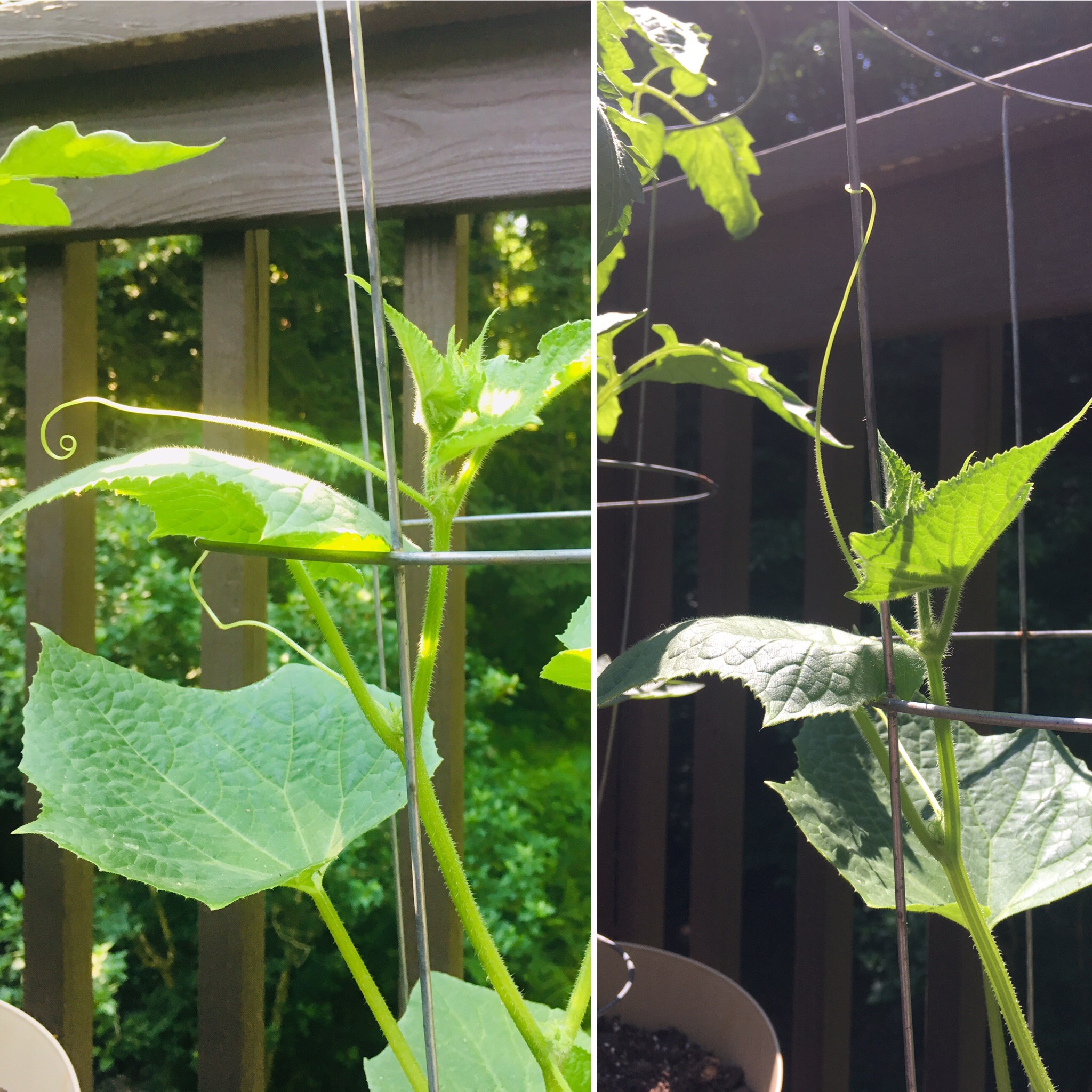
Consider the cucumber. We bought one at a plant sale my daughter’s school was having, and watching it grow has been fascinating. The students staffing the sale told us that cucumbers are climbing vines, and would need a trellis or cage to latch onto (if you’re an avid gardener, you already know this, but I’m a novice; I try to grow a few potted vegetables and herbs every summer, with varying degrees of success). We followed their instructions, and I was awed by the first little tendril that unfurled from the stem, delicately coiled as calligraphy. It listed far from the cage and I thought, there’s no way it will latch onto that! It seemed blind, like a worm or some deep sea creature, tonguing its way, vainly, into the air. But then, a day or so later, this tendril had somehow found the thin metal rib of the cage, and curled around it with such grace and precision that I felt oddly moved. That nature is ingenious and resourceful shouldn’t surprise me, but it did. It struck me as miraculous that this seemingly lost and fragile fledgling of a stem found what it needed in the night, even though it’s merely a rote machination of the plant–what it does, what it’s designed to do.
I’ve wondered if my body is functioning in a similar way. I wonder how much invisible work it does every night to heal and repair what has been ravaged. And I’ve wondered how it knows to do this, without any books, instruction, or bidding. I was in so much pain last week, and felt so vulnerable, that I couldn’t believe my doctors had sent me home to deal with it, alone. I don’t see my radiation oncologist again for six weeks. Six weeks! I would think to myself, enraged and incredulous that I’d been left to flounder through the hardest part of all this, unmonitored. But maybe it’s because there’s really nothing she could do for me, aside from prescribing the heavy regimen of pain meds. Maybe she knew that my body would begin to heal itself on its own, and my job now is to simply wait it out. Only it’s not so simple, because the process has been slow and strangely hidden from me. I wake each morning wondering how I will feel–whether the pain will have subsided some, or my energy returned. Whether my body, in its distress, will have found some kind of mooring.
I’ll take what I can get
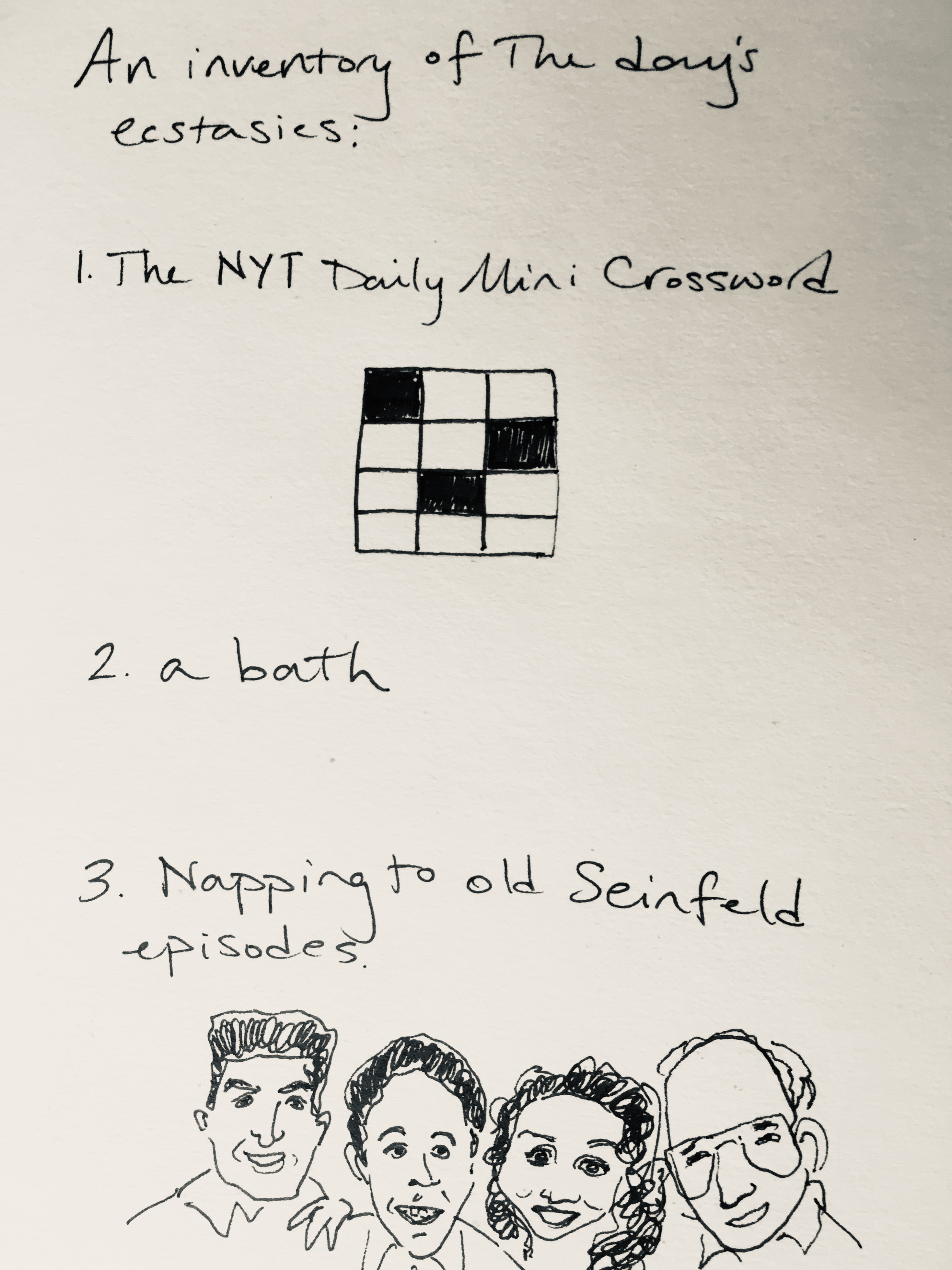
This probably gives you a good sense of where I’m at today. The hours pass at a snail’s pace, but I’m growing accustomed to this. Time is marked mostly by the dosing of different medications, in-between which I sleep or make myself drink something. Monday is a big day, however: my last radiation treatment!
Side effects may include…

While perusing my radiation packet a few months ago, I saw that a likely side effect of treating the mouth was “thick, ropy saliva.” As with so many other things I read or was told before I began treatment, I laughed (among them, my surgeon warning me that I would probably lose 15-20 lbs.). But here I am in my last week of radiation, with saliva so thick and ropy you could use it to rig a ship. Seeing is believing.
I take my waking slow
A friend who visited the other day asked me how I’ve been passing the time, and it was difficult to formulate an answer. I’m on a short term medical leave from work, but the past few months have felt nothing like the summers I enjoy off as a teacher. Those days are usually filled with leisurely errands, cooking, reading, small projects around the house, our annual trips to the beach and the lake–in short, stuff I like to do that’s more of a challenge when I’m working. And well. But right now, I’m not. This is a hard thing to accept, both for myself and for others. I want to be able to say that I’m passing the time productively–that I’m keeping apace with the world and its various demands. Or that my role in it remains an active one… But illness is really more of a passive art, as I’m slowly learning.
For example, I’ve had to increase the dosage of my pain medication, which makes me drowsy and means I can no longer drive. The radiation also causes fatigue, so I spend a good part of the day sleeping. I actually love the hours in which I’m not awake because I don’t feel any pain or discomfort. I’ve even fantasized about being put into a medically induced coma for these last few weeks of treatment (which my generally pleasant, positive doctor has said I’ll want to “blot out of my memory”), then magically awakened, like Snow White or Sleeping Beauty, when it’s all over.
The remaining portion of each day is now devoted to consuming the requisite amount of fluids, which I hate. I used to look forward to meals, but now I dread them. Swallowing is painful and requires a near herculean effort, so I work my way through a single glass of water or an 8oz. Ensure in, like, an hour. Because I’m losing weight and not getting many calories, I’ve not felt up to my daily walk. I’ll still go outside (as the weather has been beautiful), but mostly to sit on the deck or check the mailbox, savoring the sun on my skin.
In short, I’ve been convalescing. This is a rather foreign concept to our modern minds (not to mention, an outright affront to the busied, breakneck ethos of modern life), but it was once quite common. Pick up almost any 19th century novel and at least one character in it will be at–or headed to–some oceanside villa “to convalesce.” They’ll sit in a wheelchair on the shore, blanketed against the bracing sea winds, the salty air a supposed elixir of sorts. I feel oddly akin to them now, despite our differences in time and place. Just as I’m beginning to feel akin to the folks in the radiation waiting room. I see the same people at the same time every day, seated in mostly the same chairs. We smile wearily at one another, sometimes chatting a bit and sometimes not. It’s a fellowship I never sought, but will be strangely sorry to lose. Perhaps it will be succeeded by another one: survivors.
 Well, then